
Streaming has transformed from a convenience into an expectation. Audiences no longer tolerate buffering delays, resolution drops, or inaccessible media. Every interruption weakens trust, particularly in environments where digital content serves as the primary interface between platforms and users. Reliability, therefore, has become inseparable from infrastructure design.
As digital consumption expands across geographies, the structural mechanisms supporting content delivery grow increasingly complex. Platforms must balance speed, availability, and consistency simultaneously. This necessity leads to a foundational question frequently raised by technology teams and digital operators alike: what is CDN, and how does distributed delivery architecture sustain uninterrupted streaming performance at scale.
The Structural Limits of Centralized Content Delivery
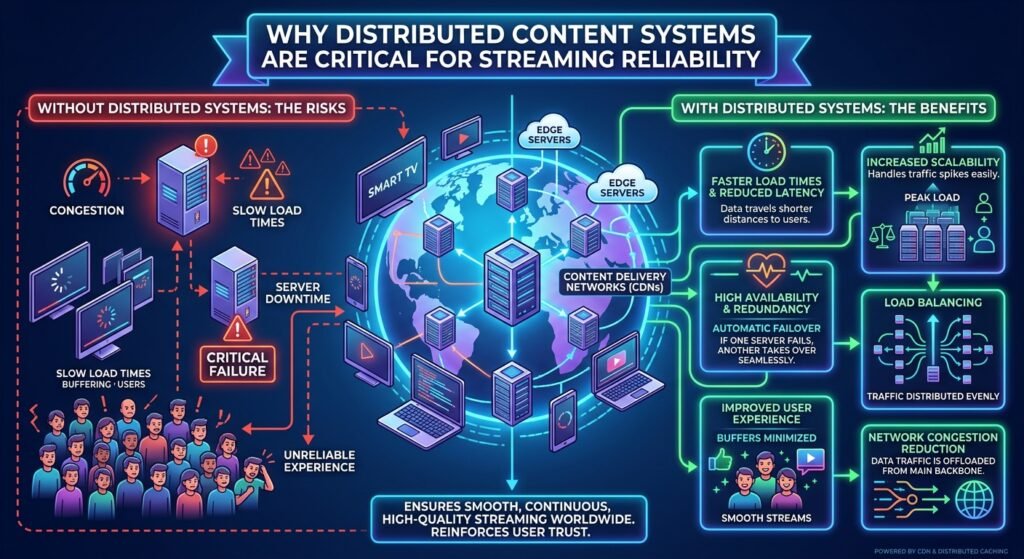
Traditional centralized delivery models were never engineered for global streaming scale. When content originates from a single server cluster, geographic distance introduces unavoidable delays. Each additional network hop increases latency, amplifies congestion risk, and weakens overall delivery stability. These structural limitations become especially visible during traffic surges or geographically concentrated demand spikes.
Distributed systems resolve this imbalance by decentralizing content availability. Instead of forcing every user request to travel across continents, content is replicated across multiple edge locations. These distributed nodes reduce the physical distance between user and data source, stabilizing transmission speed. This architectural shift converts delivery from a fragile linear path into a resilient mesh of interconnected access points.
Latency Reduction as the Core Driver of Streaming Stability
Latency, defined as the delay between request and response, directly determines whether streaming feels instant or interrupted. Even millisecond-level delays accumulate, particularly when multiple video segments must load sequentially. High latency environments often trigger buffering, resolution degradation, or playback interruptions that undermine user experience.
Distributed delivery systems counter latency by positioning content closer to consumption points. When video segments originate from nearby edge nodes rather than distant origin servers, transmission paths shorten dramatically. This proximity-based delivery model ensures faster initial playback, smoother adaptive bitrate transitions, and uninterrupted viewing continuity even under heavy network demand.
Geographic proximity minimizes transmission delay
Physical distance remains one of the most influential variables in network performance. Data traveling shorter distances encounters fewer intermediate routing steps and reduced transmission friction. Distributed delivery frameworks exploit geographic proximity by storing content near user clusters. This positioning ensures that requests resolve quickly, preventing playback delays and maintaining consistent responsiveness.
Reduced network congestion improves delivery consistency
Centralized systems concentrate traffic into limited pathways, increasing congestion probability. Distributed architectures diffuse demand across multiple nodes, preventing overload in any single region. This traffic distribution prevents bottlenecks, preserves throughput stability, and ensures streaming reliability even during peak viewing periods such as live broadcasts or major content releases.
Edge delivery supports adaptive streaming performance
Modern streaming platforms rely on adaptive bitrate protocols that adjust video quality based on real-time network conditions. These protocols require rapid communication between client devices and delivery infrastructure. Edge-based distribution accelerates this communication loop, enabling seamless resolution adjustments. The result is uninterrupted playback without visible quality disruptions or buffering delays.
Infrastructure Redundancy as a Reliability Safeguard
Reliability is not defined solely by speed but by resilience under failure conditions. Hardware faults, network outages, and regional disruptions represent unavoidable realities within global infrastructure ecosystems. Systems lacking redundancy often collapse under such stress, leaving users unable to access content entirely.
Distributed delivery models inherently embed redundancy into their architecture. When one node becomes unavailable, alternate nodes seamlessly assume delivery responsibility. This automatic failover capability ensures uninterrupted access, preserving platform continuity. Redundancy transforms infrastructure from a single point of failure into a fault-tolerant ecosystem capable of sustaining continuous operation.
Failover mechanisms prevent service interruption
Failover protocols monitor node health continuously, detecting outages in real time. When disruptions occur, traffic reroutes automatically to operational nodes. This transition occurs without user awareness, preserving playback continuity. Such autonomous recovery mechanisms ensure consistent content availability regardless of localized infrastructure failures.
Load balancing ensures infrastructure stability
Load balancing distributes traffic intelligently across delivery nodes. Instead of overwhelming individual servers, requests are allocated dynamically based on capacity and performance metrics. This equilibrium prevents server strain, maintains optimal performance thresholds, and ensures stable delivery even during sudden spikes in user demand.
Distributed caching improves response efficiency
Caching stores frequently accessed content closer to users, eliminating repeated origin server retrieval. This approach accelerates response times while reducing infrastructure strain. By minimizing redundant data transfers, caching improves efficiency and enhances streaming reliability across high-demand environments.
Security Integration Within Distributed Delivery Systems
Streaming reliability depends not only on performance but also on security integrity. Unauthorized access, content piracy, and traffic manipulation can disrupt delivery pipelines. Distributed systems incorporate protective layers that secure both content and delivery infrastructure. These mechanisms ensure that media reaches only authorized users while maintaining uninterrupted service continuity.
Encryption protocols safeguard content during transmission, preventing interception or tampering. Secure authentication systems verify user legitimacy before granting access. Distributed monitoring also detects anomalies such as traffic spikes or malicious behavior. These combined protections strengthen both reliability and trust in streaming ecosystems.
Understanding the Operational Meaning of Distributed Delivery Networks
Distributed delivery networks function as globally interconnected server clusters that replicate and deliver content efficiently. Instead of relying on a single origin location, these networks distribute data across multiple geographic nodes. This distributed presence ensures faster access, improved redundancy, and consistent performance regardless of user location.
The practical answer to what is CDN lies in its operational objective: minimizing distance, maximizing availability, and stabilizing delivery performance. By decentralizing content storage and routing, these systems reduce latency, prevent overload, and ensure continuous access. This architectural approach has become essential for platforms delivering high-volume streaming content across diverse global audiences.
Final Thoughts on the Future of Reliable Streaming Infrastructure
Streaming reliability increasingly depends on distributed infrastructure rather than centralized server models. As user expectations intensify, platforms must deliver content instantly, consistently, and securely. Distributed delivery systems provide the structural resilience required to meet these demands, ensuring uninterrupted playback even under unpredictable network conditions.
Organizations such as Doverunner operate within this ecosystem by supporting secure, distributed delivery frameworks that strengthen performance, protect content, and stabilize access across regions. Understanding what is CDN clarifies why distributed architecture remains central to modern streaming reliability. It represents not merely an optimization but a foundational requirement for sustaining scalable, secure, and uninterrupted digital media delivery.